
Tap and Drill Table
The right tap drill leaves enough metal for strong threads without making the tap bind or break. Choose a thread — or enter any diameter and pitch — and the percentage of thread you want, and this calculator finds the ideal drill diameter, lists the nearest fractional, number, letter and metric drills with the thread percentage each would give, and adds clearance hole sizes for bolts that pass through.
- Free to use
- No sign-up
- Runs in your browser
Quick answer
For a 1/4-20 (“quarter-twenty”) UNC tap use a #7 drill (0.201 in), which gives about 75% thread; a 13/64 in drill (0.2031 in) is a common substitute at about 72%. For 1/4-28 UNF use a #3 drill (0.213 in).
| Tap | Drill | Drill size | Thread engagement |
|---|---|---|---|
| 1/4-20 UNC (“quarter-twenty”) | #7 | 0.2010 in | about 75% |
| 1/4-20 UNC | 13/64 in | 0.2031 in | about 72% |
| 1/4-28 UNF | #3 | 0.2130 in | about 80% |
| 5/16-18 UNC | F | 0.2570 in | about 77% |
| 3/8-16 UNC | 5/16 in | 0.3125 in | about 77% |
| 1/2-13 UNC | 27/64 in | 0.4219 in | about 78% |
| M6 × 1 | 5.0 mm | 0.1969 in | about 77% |
| M8 × 1.25 | 6.8 mm | 0.2677 in | about 74% |
Tap drill calculator
Machinist Reference Charts
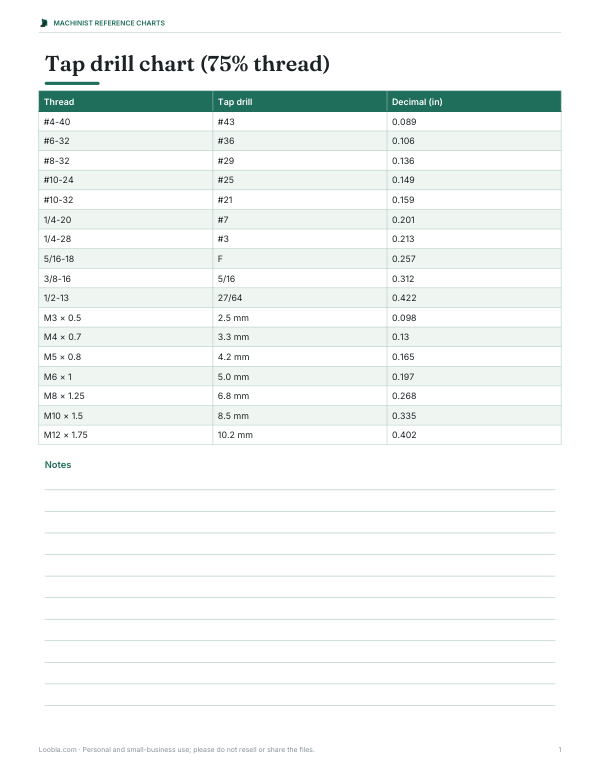
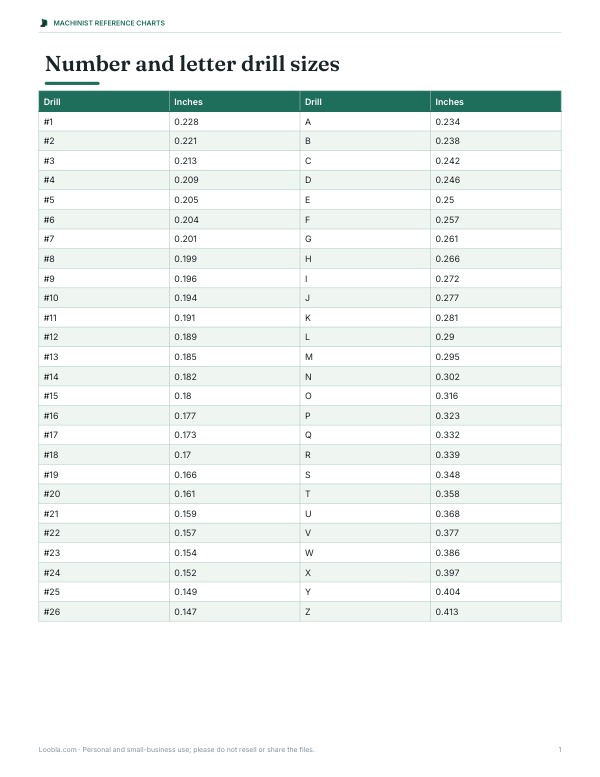
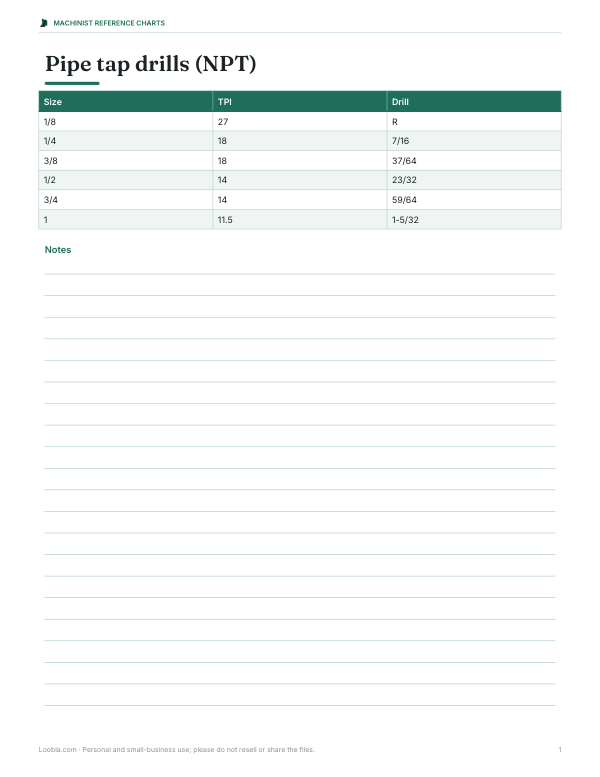
Printable machinist reference set: tap drill and clearance hole chart (inch and metric), NPT pipe tap chart, number and letter drill decimal chart and a thread identification worksheet.
- Tap drill chart (PDF/XLSX)
- Drill decimals (PDF)
- NPT chart (PDF)
- Thread ID worksheet (PDF, DOCX)
Formats: PDF, XLSX, DOCX. Instant download after payment (link valid 72 hours, up to 5 downloads). AI-assisted: the templates were drafted with AI help and reviewed and laid out before publishing.
$3.00 USD, one-time 4 files · about $0.75 each
- Instant download
- 7-day refund
- Secure checkout by Stripe
7-day money-back guarantee. Full refund within 7 days of purchase, even after you download.
Free sample: NPT Tap Chart (PDF, 62 KB)
Full refund within 7 days — see the refund policy and license.
Free printables
Single sheets you can print right now, no sign-up. The full pack adds every sheet in one download plus the editable files.
 Printable Thread ID Worksheet
Thread percentage formula
Thread percentage compares the thread you cut with a full-depth thread. For inch threads: thread % = 76.98 × threads per inch × (major diameter − drill diameter). For metric threads: thread % = (major diameter − drill) ÷ (1.299 × pitch) × 100.
Example: 1/4-20 with a #7 drill: 76.98 × 20 × (0.250 − 0.201) ≈ 75%. Around 75% is the usual target; 60–65% is easier to tap in hard or stringy material and loses little strength, because most of the load is carried by the first few threads.
Why thread percentage matters
A tapped hole never has 100% thread. The percentage describes how deep the thread is compared with a full theoretical thread. Tests have long shown that going from about 75% to 100% thread adds only a few percent of strength but roughly triples the torque needed to turn the tap, making broken taps far more likely. That is why standard tap drill charts are based on about 75% thread for general work, and 50–65% is common in hard materials, deep holes and thin sheet.
The tap drill formula
| Tap type | Formula (inch threads) | Metric equivalent |
|---|---|---|
| Cutting tap | Drill = major diameter − (0.01299 × % thread ÷ TPI) | Drill ≈ major diameter − (% thread × pitch ÷ 76.98) |
| Forming (roll) tap | Drill = major diameter − (0.0068 × % thread ÷ TPI) | Drill ≈ major diameter − (% thread × pitch ÷ 147) |
For a cutting tap at 75%, the metric formula simplifies to the familiar rule of thumb: drill = major diameter − pitch (M8 × 1.25 → 6.8 mm).
Standard tap drills (about 75% thread)
| Thread | Tap drill | Thread | Tap drill |
|---|---|---|---|
| #4-40 UNC | #43 | 1/4-20 UNC | #7 |
| #6-32 UNC | #36 | 1/4-28 UNF | #3 |
| #8-32 UNC | #29 | 5/16-18 UNC | F |
| #10-24 UNC | #25 | 3/8-16 UNC | 5/16 |
| #10-32 UNF | #21 | 1/2-13 UNC | 27/64 |
| M3 × 0.5 | 2.5 mm | M8 × 1.25 | 6.8 mm |
| M4 × 0.7 | 3.3 mm | M10 × 1.5 | 8.5 mm |
| M5 × 0.8 | 4.2 mm | M12 × 1.75 | 10.2 mm |
| M6 × 1 | 5.0 mm | M16 × 2 | 14 mm |
Clearance holes
| Screw | Close fit | Normal / free fit |
|---|---|---|
| #4 | #33 (0.113 in) | #29 (0.136 in) |
| #6 | #28 (0.1405 in) | #25 (0.1495 in) |
| #8 | #19 (0.166 in) | #16 (0.177 in) |
| #10 | #11 (0.191 in) | #7 (0.201 in) |
| 1/4 in | F (0.257 in) | H (0.266 in) |
| M3 | 3.2 mm | 3.4 mm |
| M4 | 4.3 mm | 4.5 mm |
| M5 | 5.3 mm | 5.5 mm |
| M6 | 6.4 mm | 6.6 mm |
| M8 | 8.4 mm | 9 mm |
| M10 | 10.5 mm | 11 mm |
Clearance holes are for the part a bolt passes through, not the part that is threaded. Close fit locates parts accurately; normal fit allows for small misalignment between holes.
Pipe threads (NPT)
| Pipe size | Threads per inch | Tap drill |
|---|---|---|
| 1/8 NPT | 27 | R (0.339 in) |
| 1/4 NPT | 18 | 7/16 in |
| 3/8 NPT | 18 | 37/64 in |
| 1/2 NPT | 14 | 23/32 in |
| 3/4 NPT | 14 | 59/64 in |
| 1 NPT | 11.5 | 1-5/32 in |
NPT threads are tapered, so the tap is driven in until a gauge or fitting shows the right depth; reaming the hole with a taper pipe reamer first reduces tapping torque.
Worked example
For a 1/4-20 UNC thread at 75%, the ideal drill is 0.25 − (0.01299 × 75 ÷ 20) = 0.2013 inch. The closest standard drill is a #7 (0.201 in), giving about 75% thread. In tough stainless steel you might drop to 65%, where the ideal is 0.2078 in — a 13/64 (0.2031 in) drill gives about 72%, and a #4 (0.209 in) about 63%. With a forming tap at 65%, the ideal becomes 0.2279 in, so a #1 (0.228 in) is the usual choice.
How to use the calculator
- Pick a thread from the list or enter any major diameter and threads per inch.
- Set the thread percentage — 75% for most work, less for hard materials or deep holes.
- Choose cutting or forming tap.
- Read the ideal drill size and the nearest fractional, number, letter and metric drills with the thread percentage each gives.
Metric threads are listed with their pitch converted to threads per inch internally, so results are shown in both inches and millimetres.
Tap drill for different materials
| Material | Typical thread % | Notes |
|---|---|---|
| Mild steel | 70–75% | Standard charts work well |
| Stainless steel | 60–65% | Tough and work-hardens; use sharp taps and good lubricant |
| Aluminium | 70–75% | Clear chips often; forming taps work well |
| Cast iron | 70–75% | Tap dry or with air; chips are powdery |
| Plastics | 60–70% | Avoid heat build-up; forming taps suit some plastics |
| Thin sheet | 50–60% | Few threads engage, so strength comes from engagement length |
Tapping tips
- Use cutting fluid suited to the material.
- Keep the tap square to the work — a tapping guide or drill press helps.
- With hand taps, turn forward and back a quarter turn to break chips (not needed with spiral taps).
- Chamfer the hole entrance slightly for a clean start.
- Drill blind holes deeper than the thread length to leave room for chips.
Frequently asked questions
What size drill bit for a 1/4-20 tap?
A #7 drill (0.201 in, 5.1 mm) gives about 75% thread. A 13/64 in bit (0.2031 in) also works at about 72%.
How do you calculate thread percentage?
Thread % = 76.98 × TPI × (major diameter − drill diameter) for inch threads, or (major − drill) ÷ (1.299 × pitch) × 100 for metric. The calculator above does it for any tap and drill.
What size drill for a 1/4-20 tap?
A #7 drill (0.201 in) for about 75% thread.
What size drill for an M8 tap?
6.8 mm for M8 × 1.25; 7.0 mm for M8 × 1 fine.
What is the rule for metric tap drills?
Drill size ≈ major diameter − pitch, for about 75% thread.
What thread percentage should I use?
About 75% for general work, 50–65% for hard materials and deep holes.
Do forming taps need a different drill?
Yes, a larger one — the calculator has a forming tap option.
What is a clearance hole?
A hole slightly larger than the bolt so it passes through without threading.
Why did my tap break?
Common causes are too small a drill, lack of lubricant, a crooked start or packed chips in a blind hole.